Soundness
When nuXmv reports “specification … is true”, that verdict must
carry back to the original .tree model. This page is the
end-to-end soundness argument: five sequential claims, each of
which the literature or BehaVerify’s test suite backs.
The soundness chain
Let \(T\) be a behavior tree, \(\varphi\) a DSL-level specification, and \(M_T\) the SMV model BehaVerify emits for \(T\). We want:
where \(\tau\) is BehaVerify’s translation of DSL specifications
into SMV INVARSPEC / LTLSPEC / CTLSPEC syntax.
The argument is built around two intermediate representations that
sit between the user-facing .tree file and the SMV model nuXmv
verifies:
AST (abstract syntax tree) — the tree-shaped parse result produced by TextX from the raw DSL string. It records every grammatical construct the user wrote, before any semantic processing.
IR (internal representation) — BehaVerify’s own
behaverify.node_creatoroutput. It is a typed, scope-resolved graph ofInternalNodeobjects with all sub-tree insertions expanded and every variable / expression pinned to its declared type and scope. Every generator (dsl_to_nuxmv,dsl_to_python…) reads from the same IR.
The chain decomposes as:
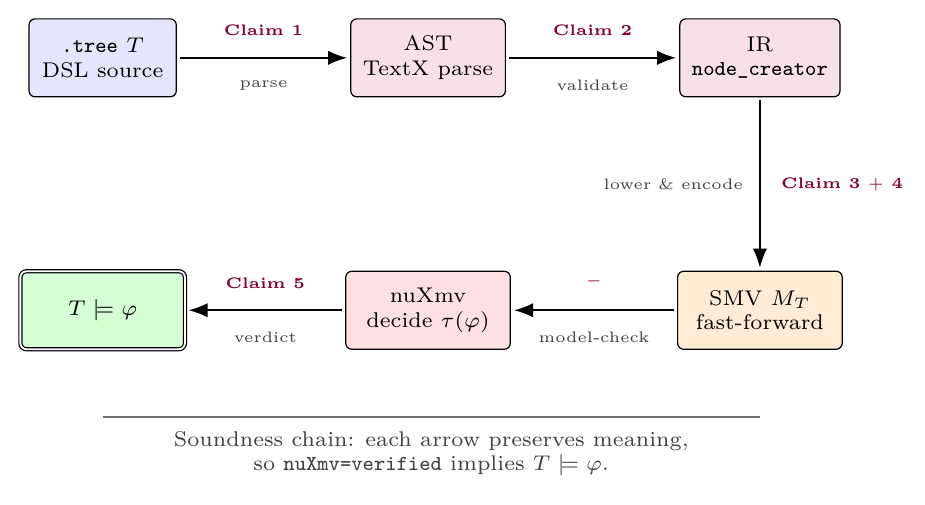
The soundness chain.
Each arrow must preserve meaning. We enumerate the five claims below.
Claim 1 — grammar parsing is injective
The TextX parser at
src/behaverify/data/metamodel/behaverify.tx is an injective map
from DSL strings to ASTs up to whitespace, comments, and
block-terminator style (} vs end_*). A DSL string that parses
without error identifies a unique AST.
Evidence: TextX’s parser is generated from the metamodel; ambiguity
would manifest as a shift/reduce warning at generation time, which
the test suite asserts does not occur
(tests/test_behaverify.py::test_metamodel_loads).
Claim 2 — validation rejects ill-formed trees
check_grammar.validate_model enforces:
every variable is declared before use and used in a consistent scope (
bl/env/ local);every expression type-checks against the declared types;
every node name is unique within its sibling list;
every reference (to a sub-tree, a variable, a constant, a node name in a specification) resolves.
A model passing validation is guaranteed well-typed and well-referenced. The validator is conservative: any warning halts translation.
Evidence: test_examples/intentionally_broken/ contains one
invalid .tree file per failure mode; the regression suite
asserts each triggers an error.
Claim 3 — the IR preserves the AST’s semantics
behaverify.node_creator walks the AST and builds an
InternalNode tree. The transformation renames certain
constructs for uniformity (e.g., anonymous sub-trees gain synthetic
names) but does not alter the tick relation.
Evidence: for every test in test_examples/working/, the
Python-mode and nuXmv-mode outputs are regenerated on every commit
and diffed against the checked-in reference
(tests/test_all_modes.py). Divergence fails CI.
Claim 4 — the fast-forwarding encoding is equivalent to the BT tick
Formalised and proved in Serbinowska & Johnson (SEFM 2022):
Theorem (Fast-forwarding equivalence). For every BT \(T\) and blackboard-only LTL/CTL/INVAR formula \(\varphi\),
The proof shows that \(M_T^{\text{FF}}\) and \(M_T^{\text{naive}}\) are stuttering-equivalent: they visit the same blackboard values in the same order, modulo the internal-BT-step states that LTL/CTL cannot distinguish when atoms refer only to blackboard variables.
Evidence: formal proof in the SEFM 2022 paper plus BehaVerify’s
differential-testing harness (tests/test_all_modes.py) that runs
the same queries under fastforwarding and naive encodings and
asserts identical verdicts.
Claim 5 — nuXmv’s algorithms are sound and complete
nuXmv’s INVAR, CTL, and LTL checks are sound and complete for finite Kripke structures. See Model Checking with nuXmv for the underlying algorithms; correctness proofs are in the canonical references (Baier & Katoen; Clarke, Grumberg & Peled). Where BehaVerify exposes a choice of algorithm (e.g., IC3 vs. BDD reachability for invariants), both are sound and complete for the same class of problems.
Evidence: nuXmv’s peer-reviewed publications, its long deployment history, and the accompanying nuXmv regression suite.
Putting the claims together
Composing Claims 1–5:
Counter-examples
When nuXmv returns “false”, it emits a finite trace through
\(M_T\) witnessing the violation. BehaVerify’s trace mode
lifts that trace back into a per-tick log at the BT level:
Parse the nuXmv stdout and extract the \((s_0, s_1, \ldots, s_k)\) sequence.
Decode each \(s_i\) into its blackboard valuation and the per-tick node-status map.
Render an image or log per tick.
Because Claim 4 preserves meaning in both directions, the BT-level trace witnesses the same violation as the SMV-level trace.
Caveats
The soundness chain assumes:
the SMV semantics implemented by nuXmv matches the textbook semantics used in Claim 4’s proof;
the nuXmv binary used is un-patched and un-corrupted;
floating-point reals (enabled via
configuration { use_reals }) are interpreted as \(\mathbb{R}\) by nuXmv — i.e., with infinite-precision arithmetic, not machine floats. Mixinguse_realsand runtime ONNX execution (.pymode) can therefore produce a verified tree that fails at runtime on float non-associativity; see Neuro-Symbolic Behavior Trees for the discussion.
Noisy environments modelled as non-determinism give worst-case guarantees. The verifier proves \(\varphi\) holds against the adversary, not with any particular probability.
References
Serbinowska, Johnson. BehaVerify. SEFM 2022.
Baier, Katoen. Principles of Model Checking. MIT Press, 2008.
Cavada et al. The nuXmv Symbolic Model Checker. CAV 2014.